From your data to a governed model, on your own GPUs
InsightDLM is a control plane, an engine controller and a secure inference gateway that you install in your Kubernetes cluster. The control plane keeps the record; the engine runs every GPU job on the pools you register; the gateway is the only way to reach a model. Each stage below writes to the same lineage, so any model in production traces back to its data, recipe, evaluations and approvers.
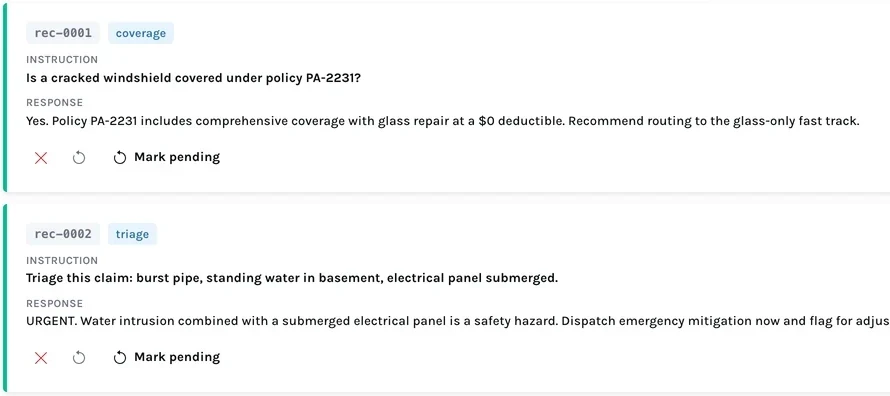
Training data people have actually read
Connect the sources where the knowledge lives, generate instruction or extraction records from them, and review each record before it trains anything.
- Connectors — SharePoint, OneDrive, Confluence, Jira, ServiceNow, Slack, Teams, Outlook, GitHub, Tableau, Power BI and databases
- Generation — a teacher model drafts records from the content you select (hosted teacher by default; plan for that on sensitive data)
- Review — accept, edit or reject record by record; edits feed back into the next generation
- PII/PHI — redaction and near-duplicate removal in curation jobs; a classification label on every dataset
Any approved open model, the right method, on GPUs that fit
A recipe is the whole configuration in YAML, so the same recipe on the same frozen dataset is the same experiment. The engine turns each run into a Kubernetes workload.
SFT, LoRA, QLoRA
TRL and PEFT on one node, Unsloth kernels on one GPU, or Kubeflow Trainer with DeepSpeed across nodes.
- QLoRA fits the small models on one 24 GB GPU
- Adapters co-served on one base at deploy
DPO and ORPO
After SFT, shape tone and judgement from chosen and rejected answers — including reviewers’ edits in the Curation Studio.
- Reference model is the base with the adapter off
- Same gates as any other version
GRPO with rewards you test
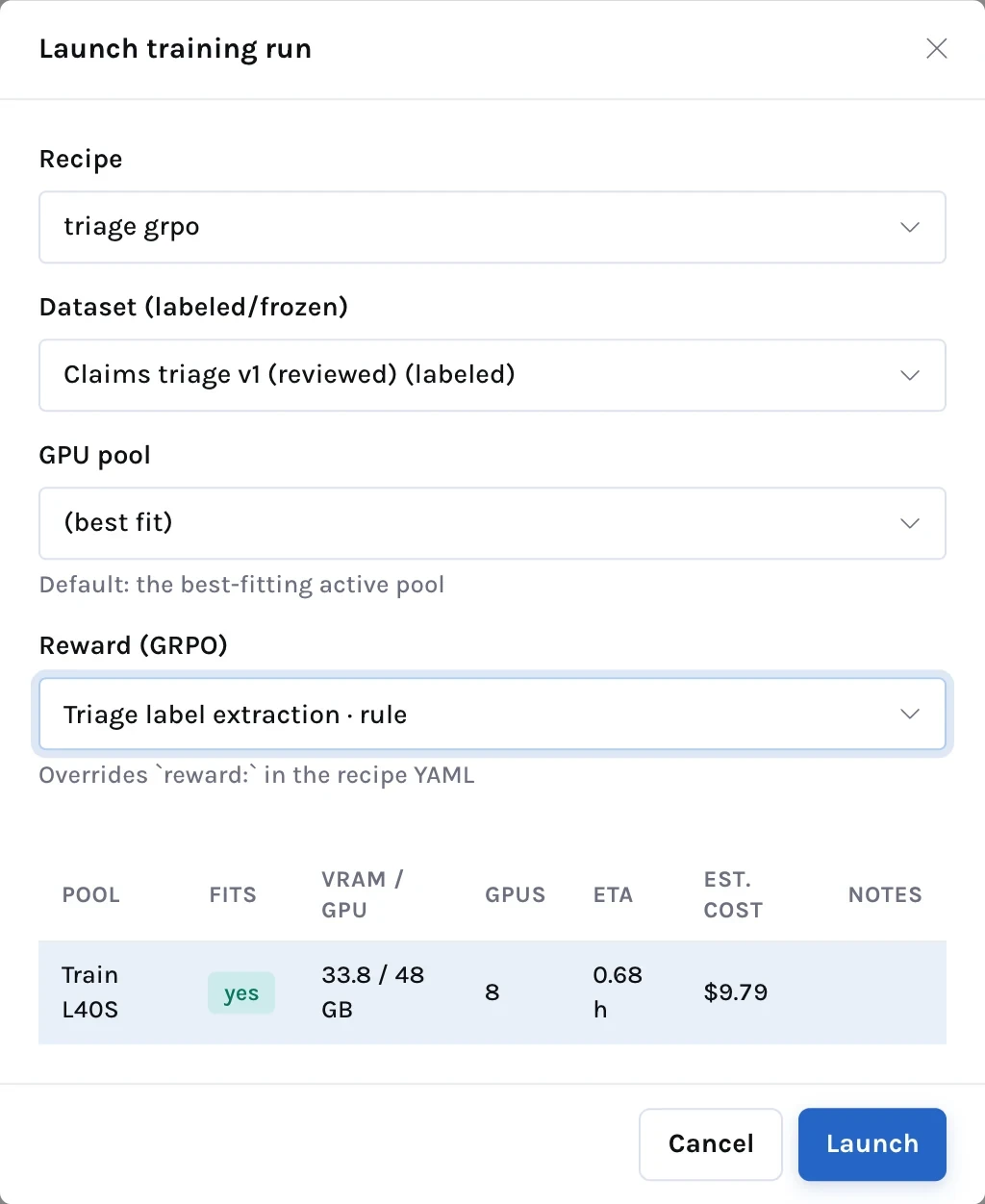
Rule and judge rewards defined in the console, tested on sample answers, and run by the same code in training.
- JSON schema, field match, regex, keywords, length, numeric
- Multi-node GRPO on Ray
The fit check, before the queue
Register your GPU node groups as pools — or discover them from the NVIDIA GPU Operator’s labels. When a run is launched, InsightDLM estimates memory per GPU, GPUs, hours and cost for each pool and refuses a run that won’t fit, with a suggestion.
- Jobs are created suspended in your Kueue queues and wait for quota
- Offline from Hugging Face; base models from your mirror, digest-checked
- Progress streams back live; restarts resume where they left off
Read the cases, not just the score
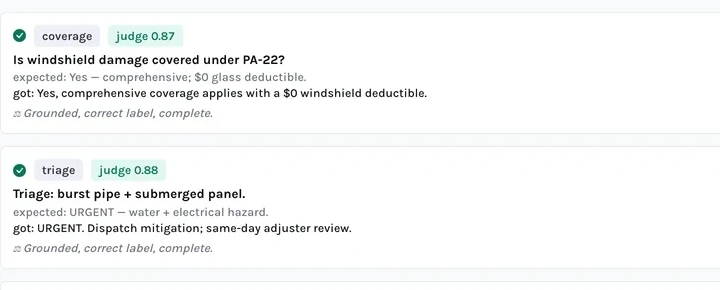
- Suites — domain Q&A on a held-out golden set, safety (it must refuse), regression, judge-only
- Judge in your cluster — a large open model behind your gateway grades against your rubric
- Every case kept — the prompt, the expected answer, the model’s answer and the rationale
- Compare versions side by side before promoting
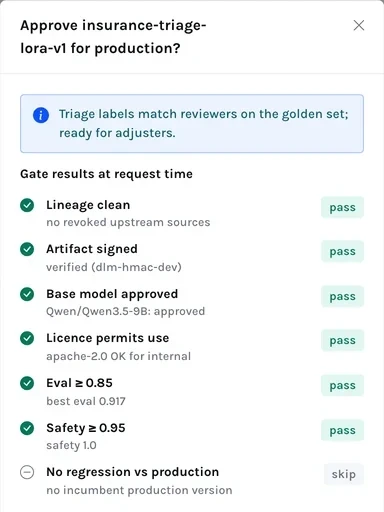
Nothing ships that can’t account for itself
Thresholds are Helm values, versioned with your infrastructure. A failed gate refuses the promotion and lists exactly what is missing.
Approved open models
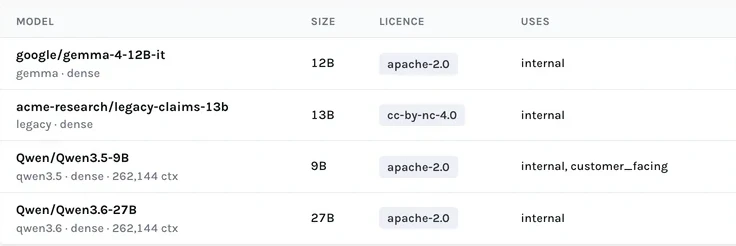
Requested, mirrored, scanned and digest-pinned. Pickle weights rejected; custom code needs an explicit sign-off; licence checked against your use.
Every version signed
The manifest of base, data, recipe and weights, signed with your HMAC or KMS key and checked again at deploy and promotion. CycloneDX AI-BOM export.
Evidence before production
Evaluation and safety thresholds, no regression against production, a compatible licence, and an approver who isn’t the requester.
Revocation that follows
Withdraw a source or a base model and every dataset, model and deployment built on it is tainted until retrained.
Authenticate → Authorize → Guard → Route → Guard → Audit
The secure inference gateway is OpenAI-compatible, so existing SDKs and agent frameworks work unchanged. Model servers accept traffic only from it.
Who
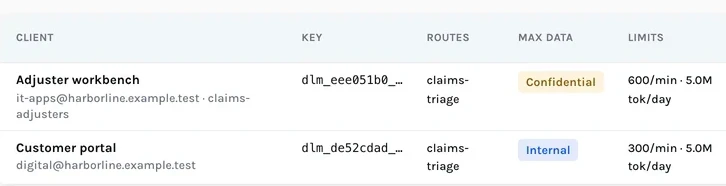
API keys per application (hashed, rotatable) or your IdP’s tokens; routes and quotas per caller.
Allowed
Ordered allow/deny policies by IdP group or application, and a data-classification ceiling.
Guarded
PII/PHI masked, tokenised or refused; prompt-injection and topic gates; classification set from what is found.
Routed
Cheapest confident tier, escalating one at a time. Sensitive requests can never reach an outside model.
Recorded
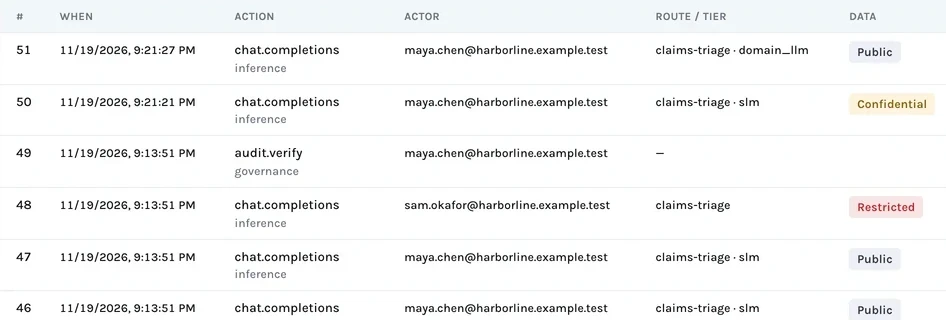
Output checked for leakage and safety, then a hash-chained audit record, bodies encrypted with your key.
Escalations become the next training set
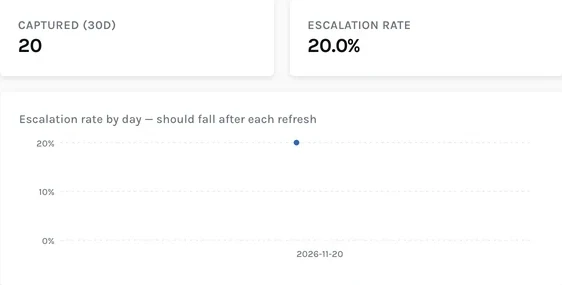
When the small model is unsure, the gateway passes the request to a larger on-network tier and, with capture on, keeps the redacted prompt and the answer. A harvest turns them into a dataset for review; a scheduled refresh can do it on a threshold.
- Escalation rate and reasons by route, by day
- Application feedback joins the next harvest
- New versions still pass every gate before they serve
Three namespaces, your infrastructure around them
Installed with a Helm chart: a minimal profile for a pilot on one or two GPUs, a production profile, and an air-gap profile with egress off.
Control plane & gateway
Console, API, scheduler, the engine controller and the autoscaled gateway. No GPUs.
- Your MySQL or Postgres
- Your OIDC provider; your KMS
Short-lived jobs
Curate, train, evaluate and quantize as Jobs, TrainJobs or RayJobs, queued by Kueue.
- Non-root, offline, digest-checked inputs
- Egress only to your object store
Model servers
vLLM with several LoRA adapters on one base model, tensor-parallel when needed.
- NetworkPolicy: only the gateway
- Signature verified before serving
Platform screens on this page come from the console’s built-in simulator with made-up data; no figure shown is a measurement.