A model built from your data is an asset you have to be able to account for. Where did its base model come from, and is its licence compatible with how you will use it? Exactly which data and recipe produced this version? Who decided it was good enough, on what evidence? If a data source is withdrawn, which models learnt from it? InsightDLM answers each of these from records it keeps as a side effect of normal work, and refuses to serve a model it cannot account for.
1. An allow-list of open models
Open-weight models are third-party software. A team asks for one by its Hugging Face id, licence and intended uses. A mirror job copies a pinned snapshot into your object store (or, on an air-gapped cluster, you copy it in yourself) and reports its file manifest. InsightDLM scans it: pickle-based weight files, which can run code when loaded, are rejected; models that need custom Python code are flagged and need an explicit sign-off; every file must have a hash so the snapshot can be pinned. An approver then approves or rejects it. Once an allow-list exists, a training run on any other model is refused.
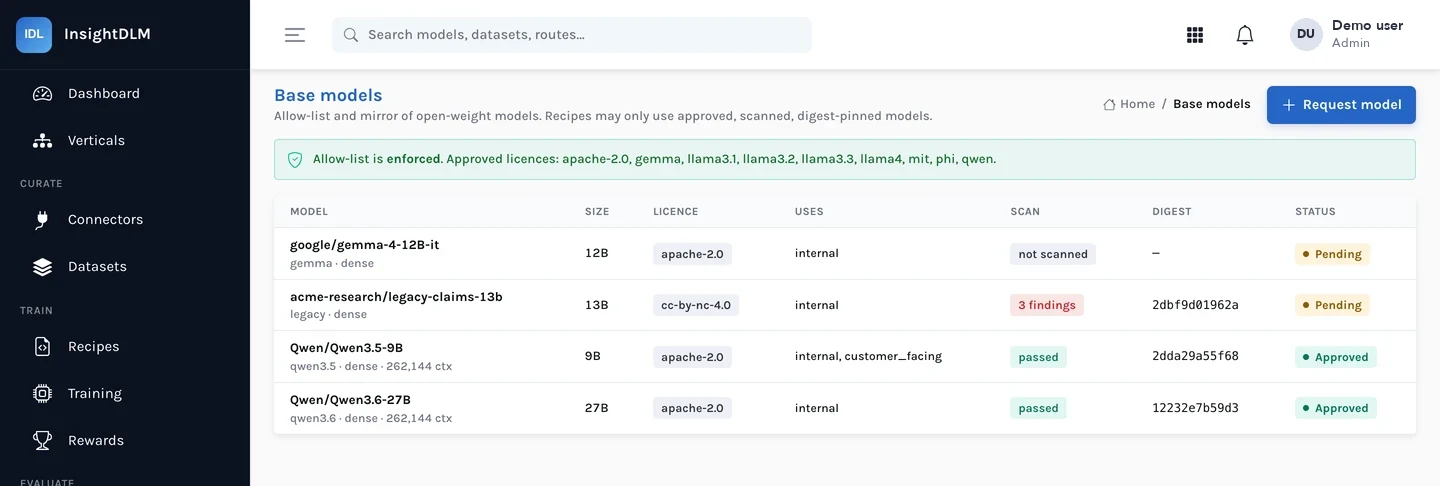
Licences are checked twice: against the organisation's list of approved licences when a model is approved, and against the use the project declares (internal, customer-facing, commercial product or research) when a model built on it is promoted. A non-commercial licence will not reach a customer-facing route. See the open-model catalog for the licence tag of each current model.
2. Every model is signed
When a training run finishes, InsightDLM writes a manifest for the new model version (its base model and digest, the dataset version, the recipe, the run, where the weights live and the digest of the weight files) and signs the manifest's digest with your key: an HMAC key you hold, or an asymmetric key in your cloud KMS. The signature is checked again when a model is deployed and when it is promoted. If the weights or any part of the manifest change after signing, the check fails and the deploy is refused.
From the same records InsightDLM exports an AI bill of materials in CycloneDX format: the base model with its licence and digest, the dataset, the evaluation metrics and the approvals, ready for a security or procurement review.
3. Promotion gates
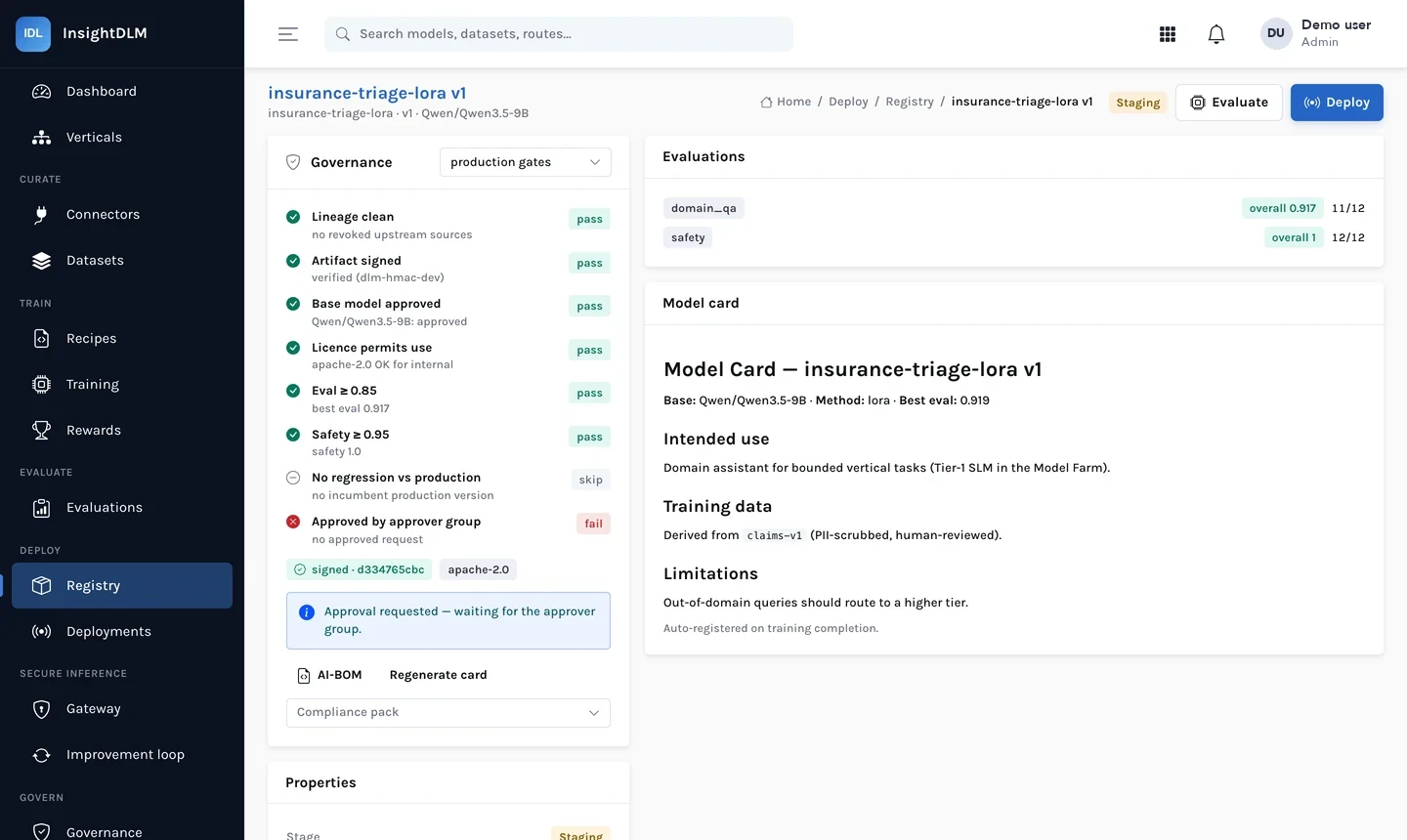
Moving a version to staging or production runs a set of gates. Staging needs a clean lineage, a valid signature, an approved base model, a compatible licence and a minimum evaluation score. Production adds a passing safety suite, no regression against the current production version beyond a set tolerance, and an approval. If any gate fails, the promotion is refused and the failing gates are listed, so the person promoting sees exactly what is missing.
| Gate | Staging | Production | Where the threshold is set |
|---|---|---|---|
| Lineage clean (no revoked source) | ✓ | ✓ | — |
| Signed, manifest unchanged | ✓ | ✓ | policy.requireSignedArtifacts |
| Base model approved on the allow-list | ✓ | ✓ | policy.enforceModelAllowlist |
| Licence permits the project's use | ✓ | ✓ | policy.allowedLicenses |
| Evaluation score at or above | 0.75 | 0.85 | policy.gates.minEval* |
| Safety suite at or above | 0.95 | policy.gates.minSafety | |
| No regression vs production | ≤ 0.02 drop | policy.gates.maxRegression | |
| Approved by the approver group | ✓ | oidc.approverGroup |
Thresholds are Helm values, so they are versioned with your infrastructure rather than changed in a settings screen. The defaults above are a starting point; set them to what your validation team agrees.
Approvals, with segregation of duties
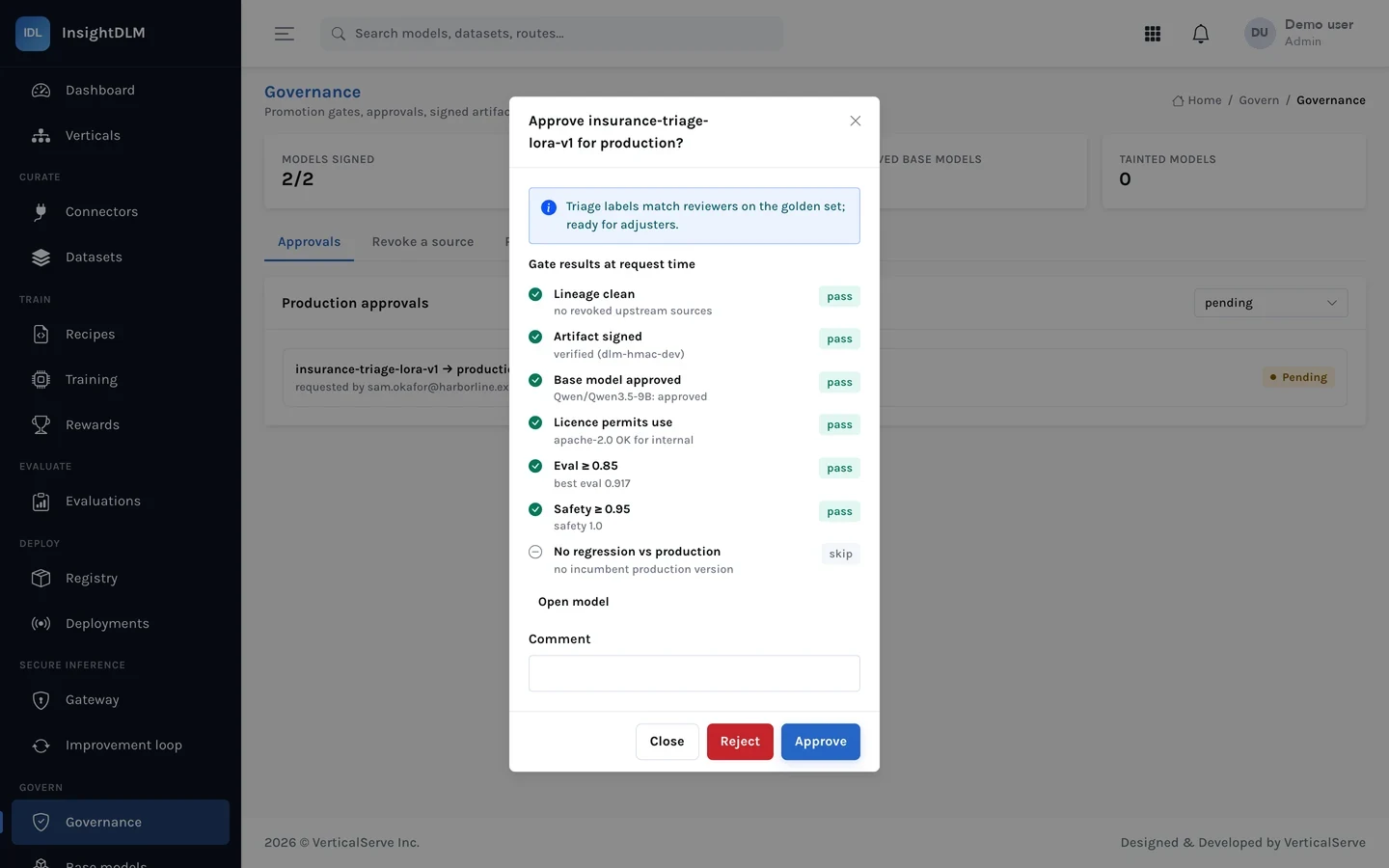
A request for production can only be raised once every other gate passes, and it records the gate results at that moment. A member of the approver group then approves or rejects it with a comment; the person who asked cannot approve their own request. Gates are re-checked when the approver decides, in case an evaluation was re-run in between.
4. Revoking a source: lineage-aware taint
If a data source has to be withdrawn (consent revoked, a file that should never have been included, a contract that ended), mark the connector or dataset as revoked. InsightDLM walks the lineage: child dataset versions, the runs that trained on them, the models those runs produced (including quantized copies) and the deployments serving them. A dry run shows the impact first. Applied, every affected model is tainted: it cannot be promoted or newly deployed, and the recipes to re-run are listed. Revoking a base model on the allow-list taints the models built on it in the same way.
5. The audit chain
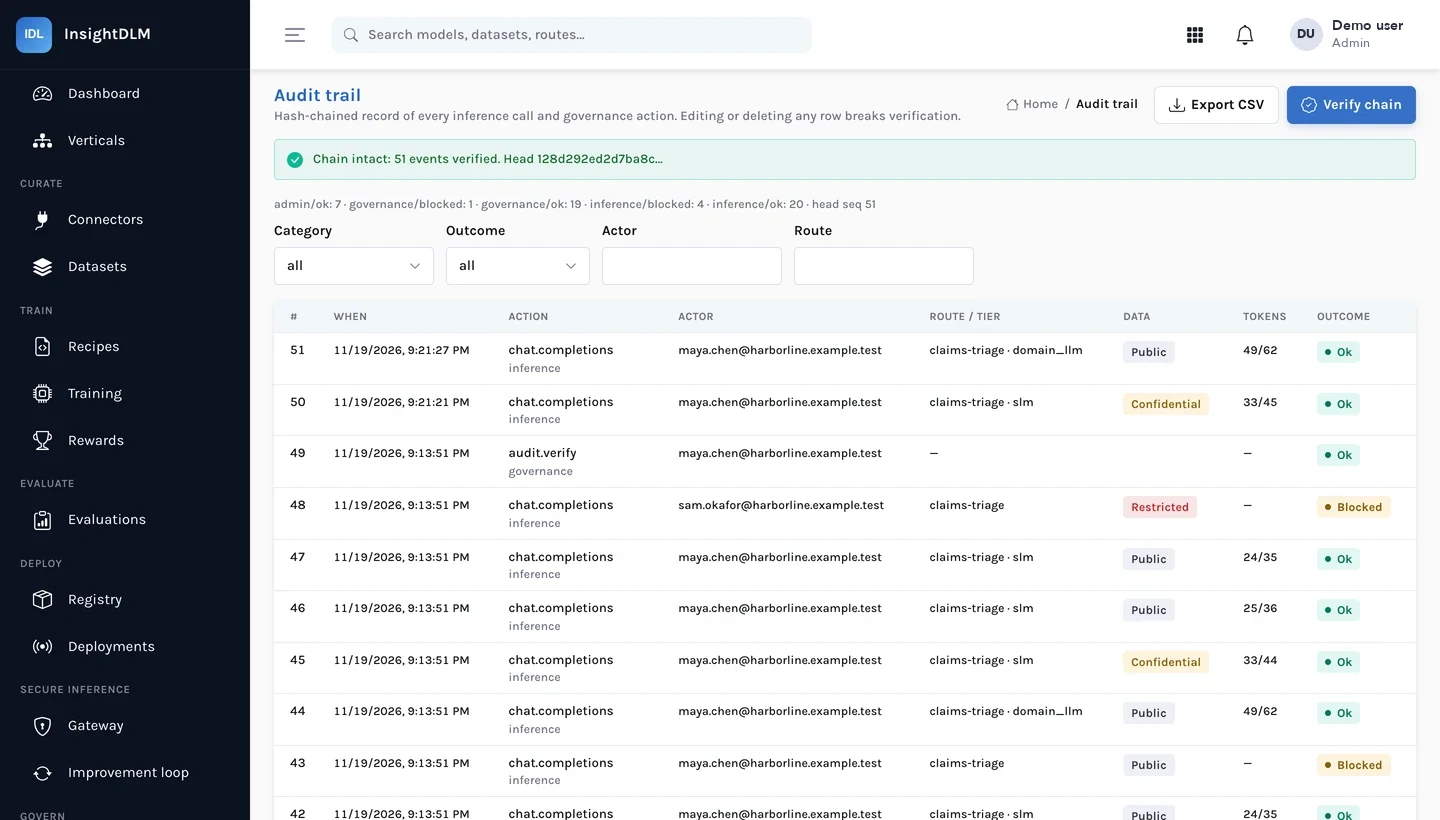
Every gateway call and every governance action (base model approved, model signed, promotion allowed or blocked, approval decided, source revoked, client key rotated) is an event in one hash-chained log: each record's hash covers its content and the previous record's hash. Verify chain recomputes all of them; an edited, deleted or reordered row shows exactly where the chain breaks. Prompt and response bodies are stored encrypted with your key, as a digest only, or not at all, and reading an encrypted body is itself audited. The log exports as CSV for your SIEM.
Evidence packs
For a model version, InsightDLM assembles what it already holds (model card, gate results, lineage, signature, audit references) into a pack mapped to the sections of three common frameworks: the EU AI Act technical documentation, the NIST AI Risk Management Framework, and an SR 11-7-style model risk inventory entry.
What the model validator asked for, and where it was
The validator asked four questions about the complaints-classification model: what it was trained on, how it was tested, who approved it and whether anything has changed since. The AI-BOM and model card answered the first two, the approval record answered the third, and a passing signature check plus a verified audit chain answered the fourth. None of it had to be reconstructed after the fact.