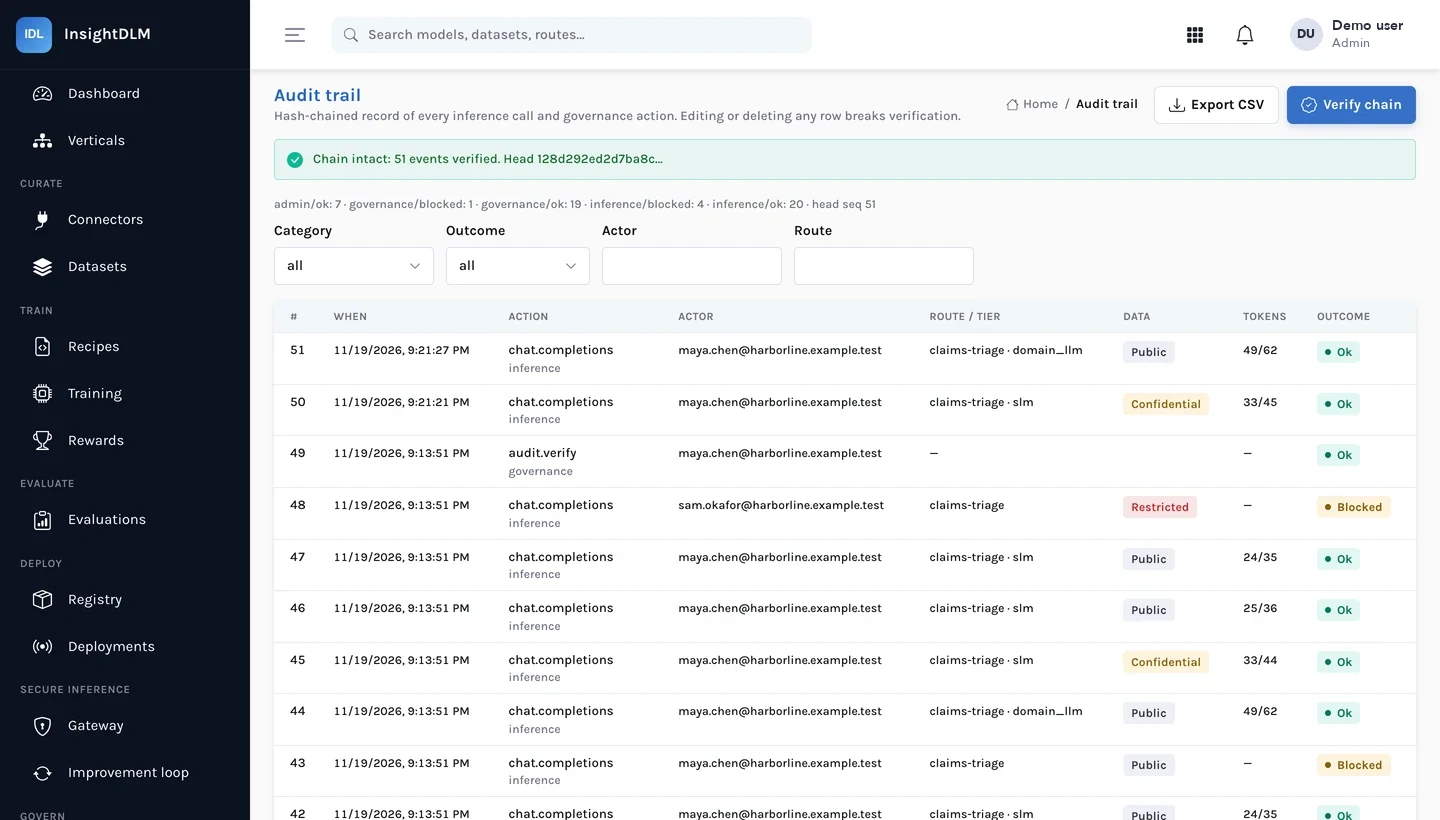
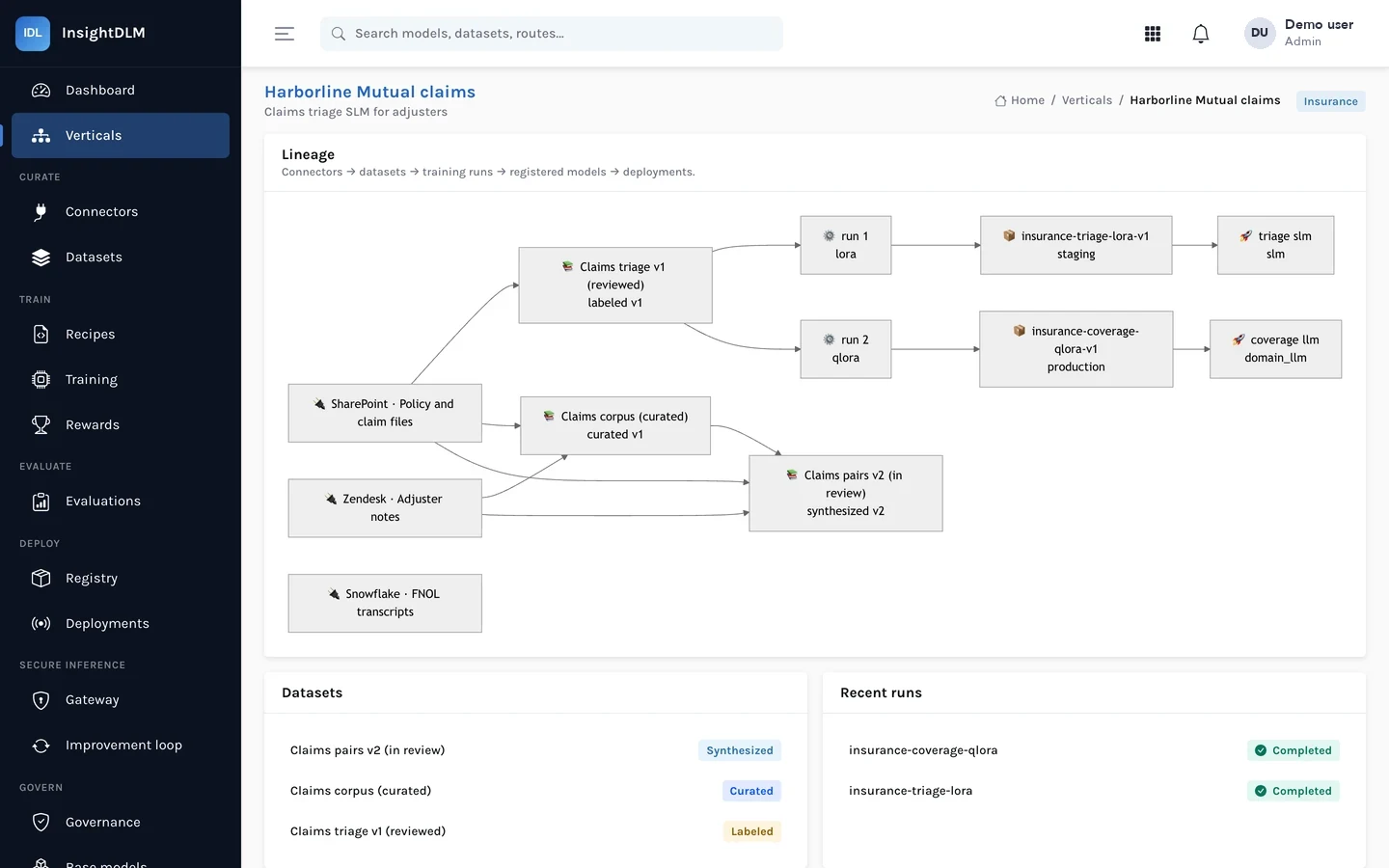
A domain model is never finished. Policies change, products launch, customers ask things nobody anticipated. The question is not whether a model will meet requests it cannot handle but whether you find out, and what you do about it. InsightDLM's answer starts in the gateway: when the small model is not confident, or a request is too complex for it, the gateway passes it to a larger tier. Each of those escalations is a precise, labelled example of where the small model falls short, and the larger tier's answer is a candidate for what it should have said.
Capture: what is kept, and what is not
Capture is switched on per route. When it is on, the gateway stores the redacted prompt (after its PII step,
so the values it masked are never stored), the answer, which tier produced it, whether and why it escalated, and any feedback the
application sent for that call (POST /v1/feedback/{audit_id} with -1, 0 or 1 and a comment). Each capture links to
its audit record.
Harvest and review
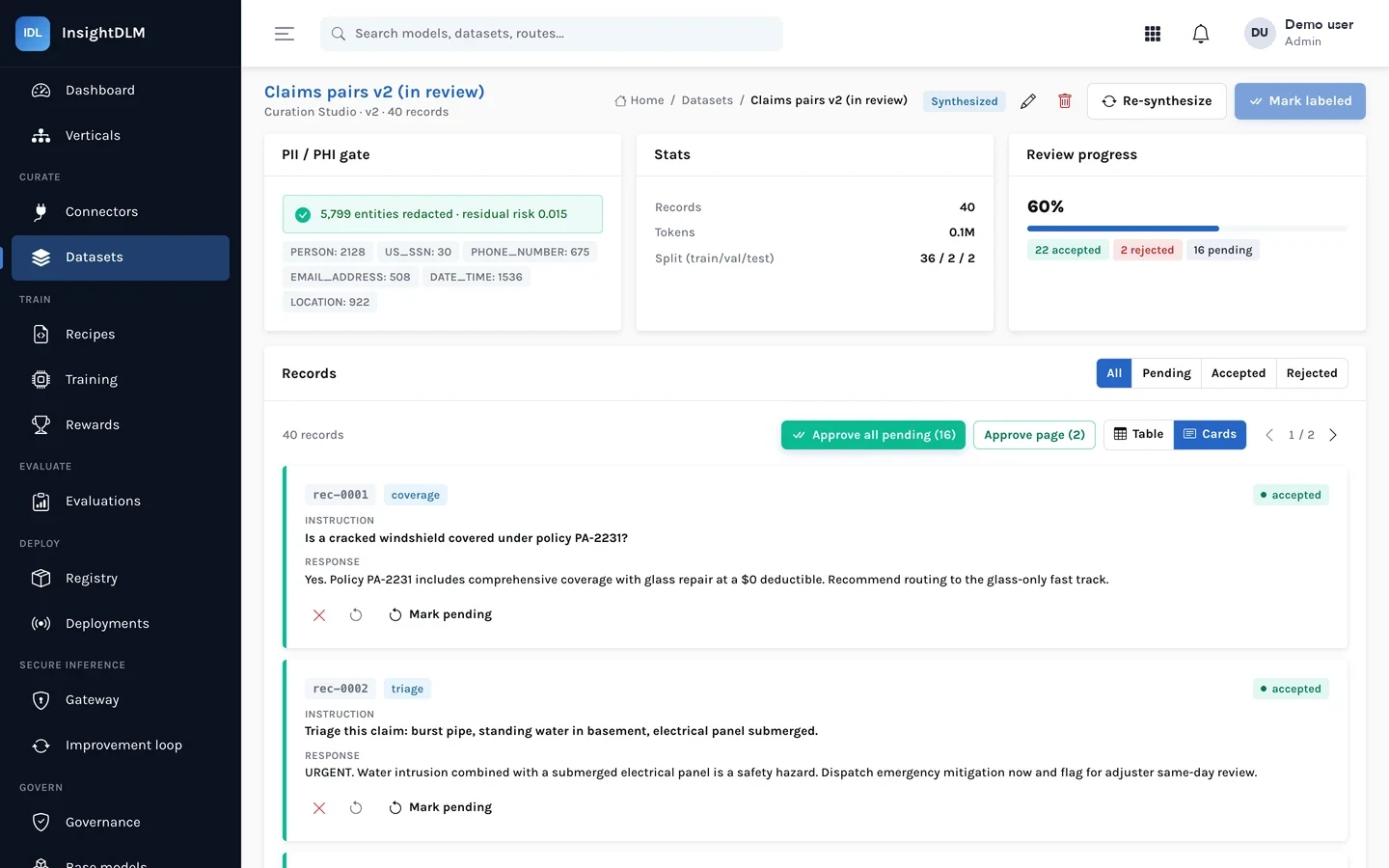
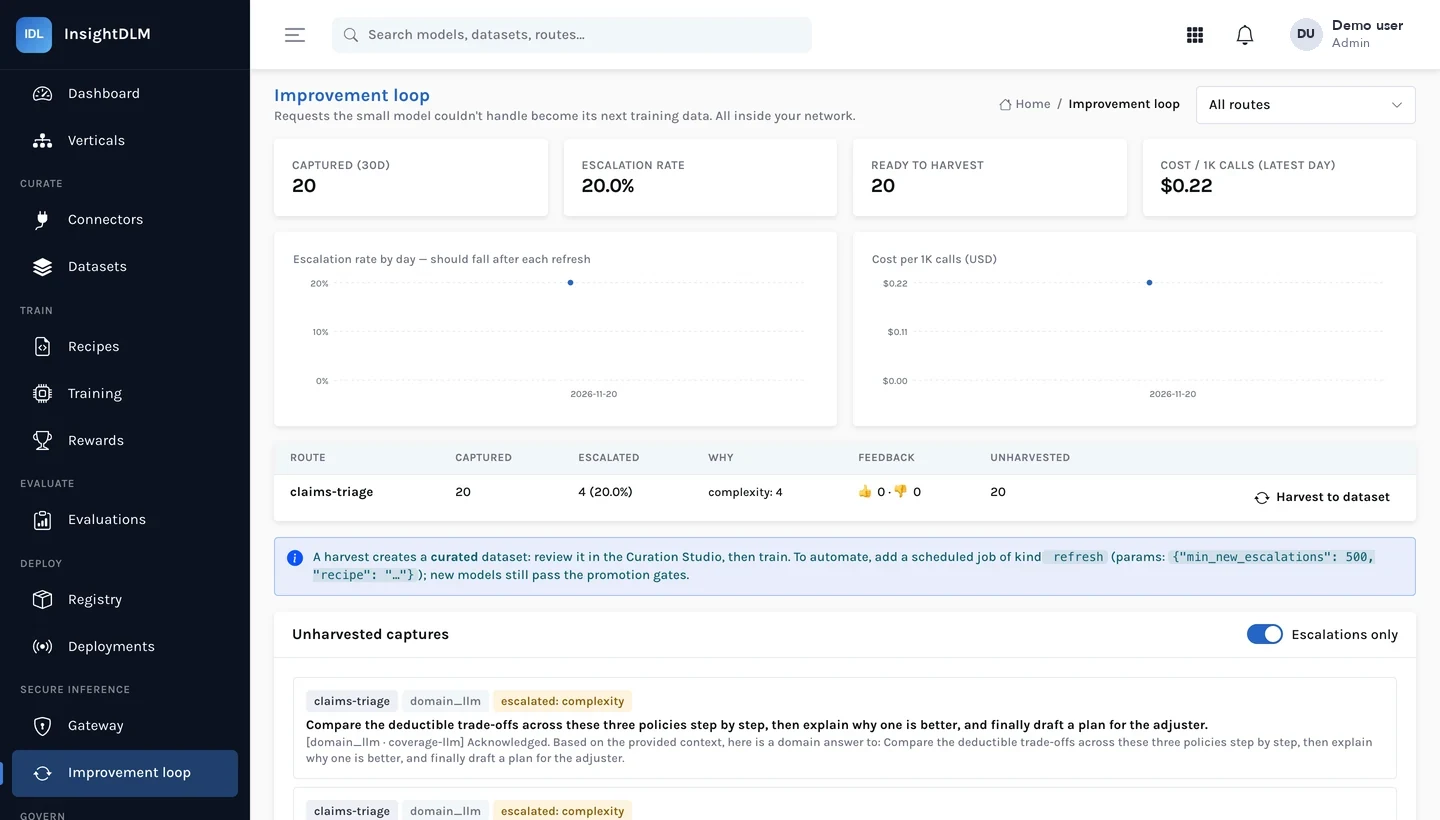
A harvest turns a route's unharvested escalations (and, optionally, calls with negative feedback) into a new dataset at the curated stage: each record holds the prompt and the higher tier's answer as the proposed target, with its escalation reason and feedback attached. It then goes through the same Curation Studio review as any other dataset: reviewers accept, edit or reject each record. A larger model's answer is a draft, not ground truth; the review is what makes it training data.
Retrain, evaluate, re-point
- Train a new version from the reviewed dataset, starting from the current production model's recipe.
- Evaluate it against the same golden set as the version in production. The no-regression gate refuses a version that improves on the new cases by getting worse on the old ones.
- Promote with approval, then deploy with the same route name. The route now points at the new version; applications do not change.
- Watch the escalation rate on that route in the following weeks.
Automating it
A scheduled job of kind refresh checks a route on a timer and harvests once enough new escalations have accumulated
(for example 500). By default it stops there and notifies the team through a webhook, because the review step needs people. A team that has decided
to skip review for a low-risk route can set the job to accept the harvested records and start training automatically; the new
version still has to pass every promotion gate before it serves.
| What to watch | Where | What it tells you |
|---|---|---|
| Escalation rate by route, by day | Improvement loop | Whether the small model is covering more of the traffic |
| Escalation reasons | Improvement loop | Low confidence (the model is unsure) vs complexity (the task is too big for the tier) |
| Cost per 1,000 calls | Improvement loop | The effect of the tier mix on spend, using your per-tier costs |
| Negative feedback | Improvement loop, audit | Answers that were confident and wrong, which escalation alone will not find |
Learning the questions the model was never taught
A month after launch, most claims-triage escalations were multi-step comparisons (several policies, a deductible trade-off) rather than triage. Two decisions followed. Comparisons stay with the Tier 2 model, because they are rare and need it. And the smaller group of escalations that were plain triage questions about a new product line were harvested, reviewed and used to train the next version of the small model.