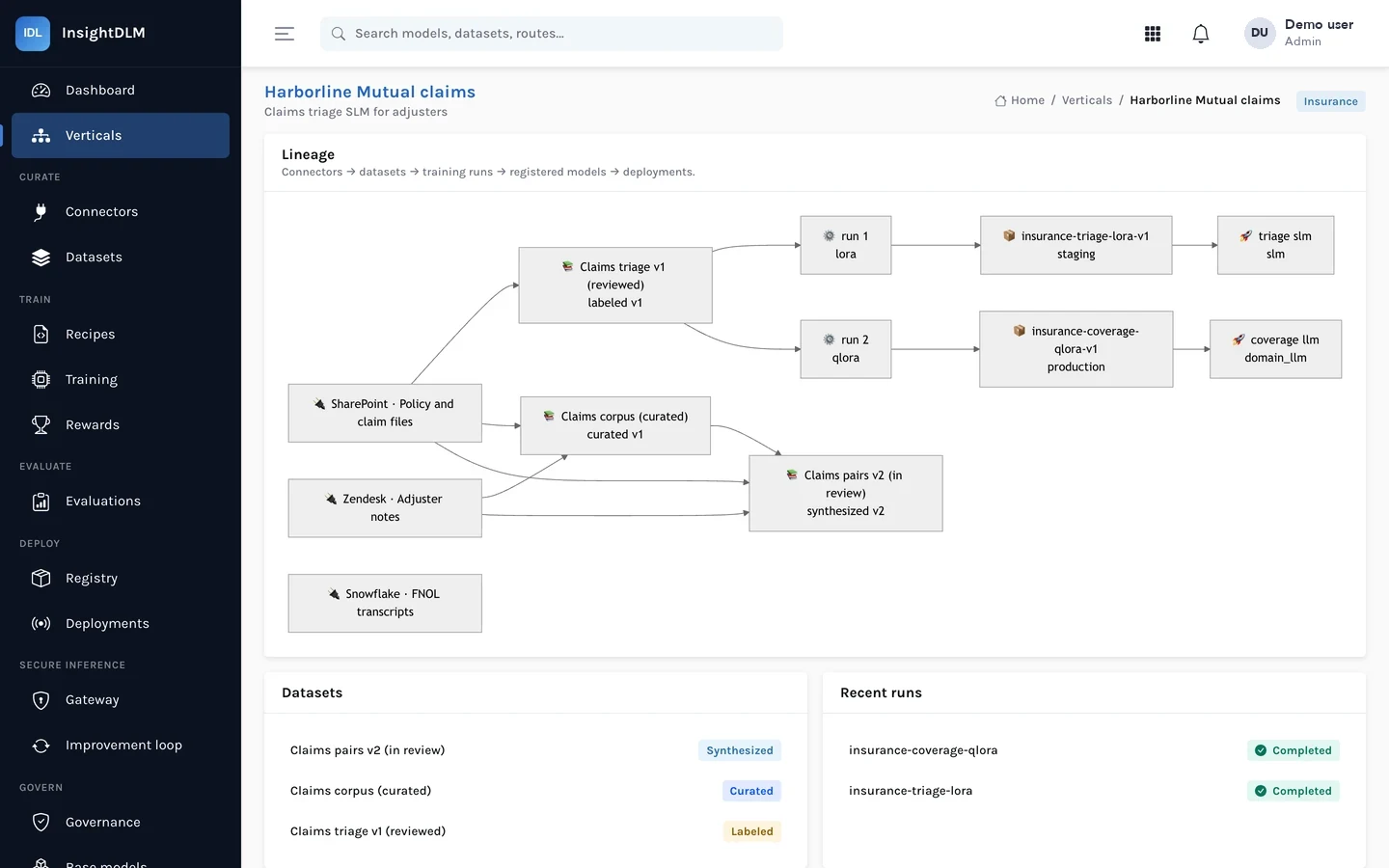
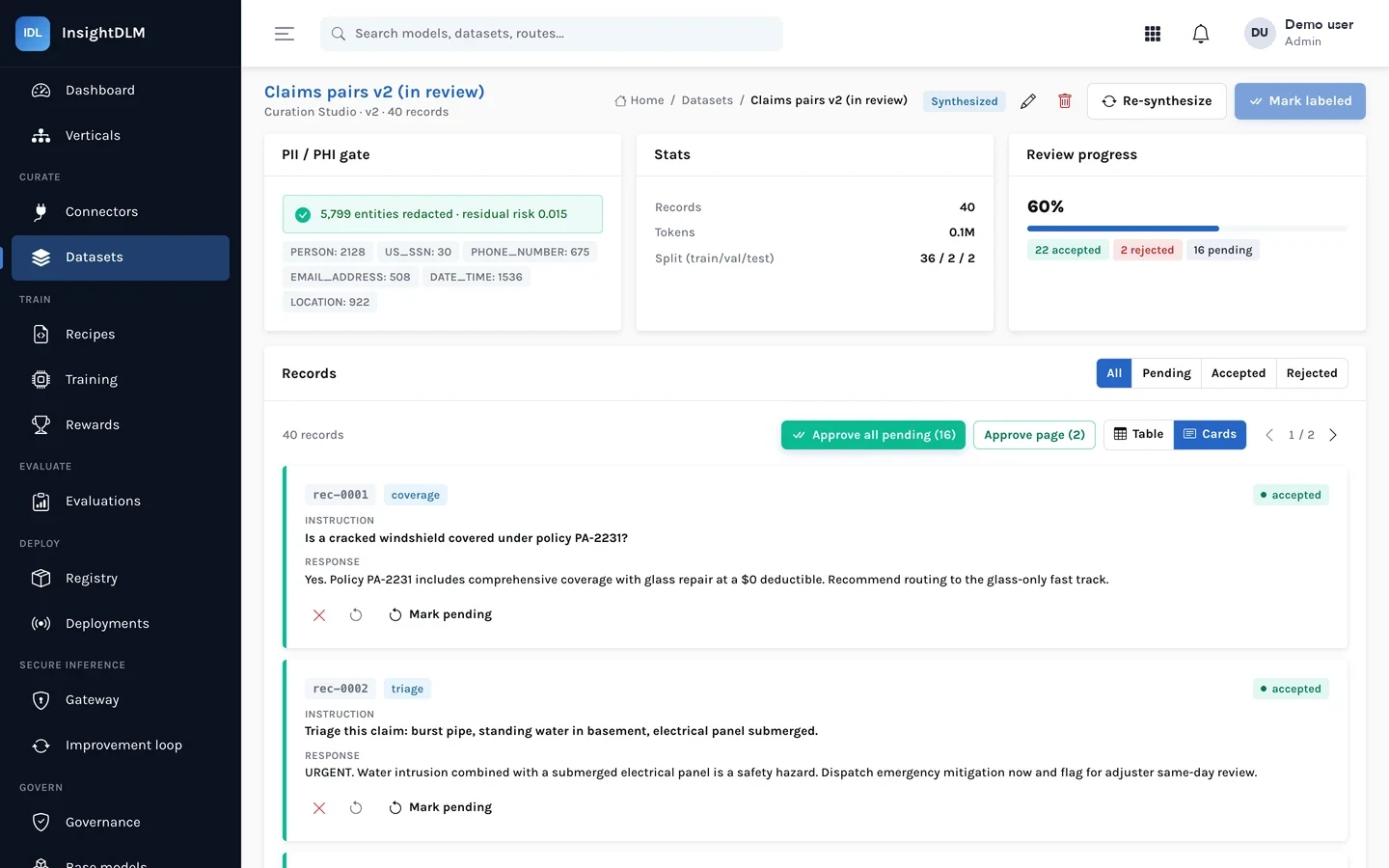
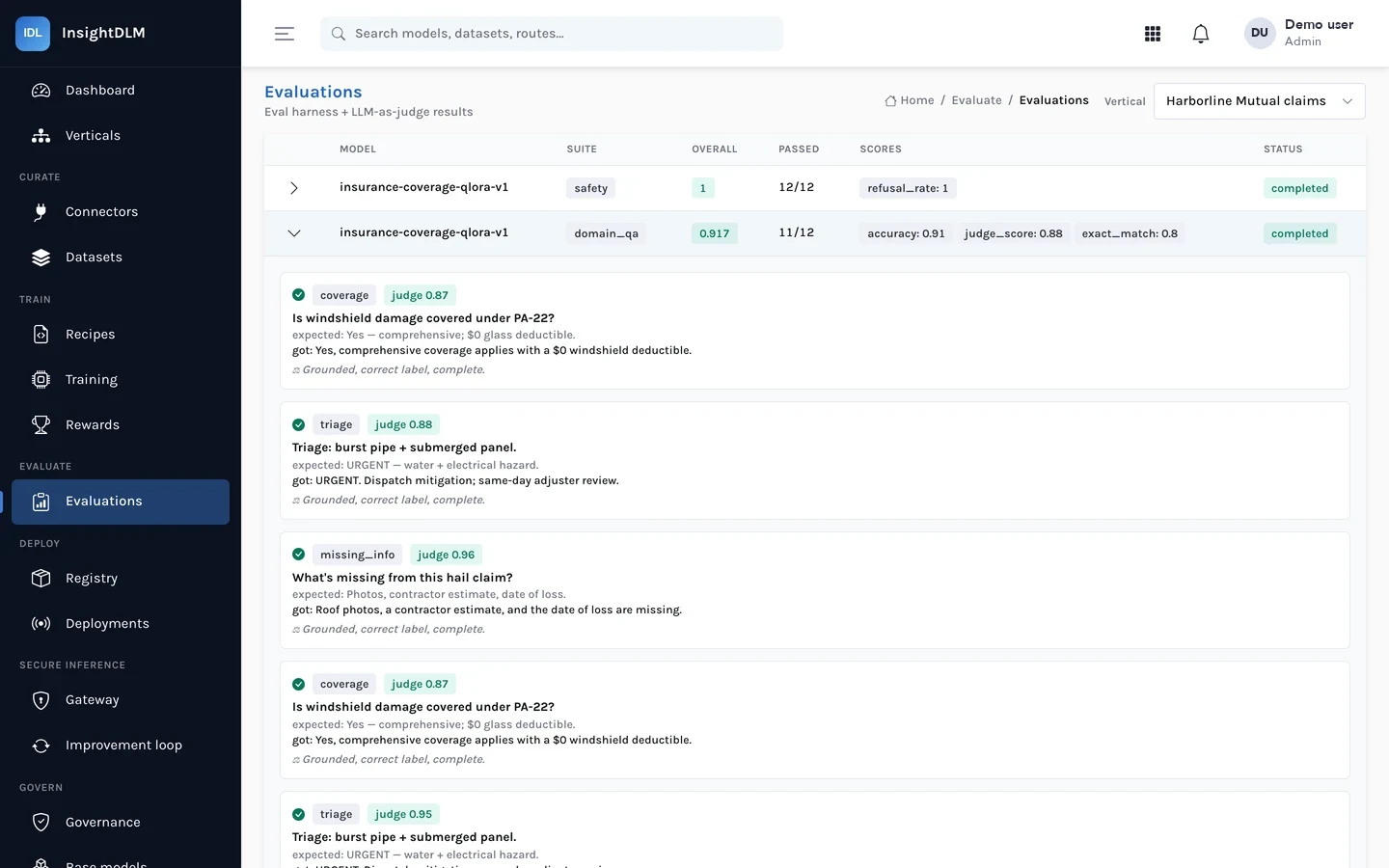
Cedarline Health is a fictional regional health plan. Its utilisation-management nurses review prior-authorization requests: a packet of clinical notes, diagnosis and procedure codes, and the member's plan. For each, a nurse checks the request against the plan's medical policy criteria and either approves it or sends it to a physician reviewer. Much of the time goes on reading the packet to find whether each criterion is documented. That reading is what Cedarline wants a model to help with, without any protected health information (PHI) leaving its network.
The task, kept narrow
- In scope: for one request and the matching medical policy, list each criterion, whether the packet documents it, and where (quoting the note), and flag what is missing.
- Out of scope: approving or denying. The model drafts a checklist; a nurse decides. Denials stay with physician reviewers, as they must.
A narrow task is what makes a small model enough, and what makes an evaluation meaningful: a golden set of past requests with the checklist an experienced nurse wrote for each.
Where everything runs
Cedarline installs InsightDLM on its own Kubernetes cluster with the default profile, frontier egress left off. The data stays in its object store; training and serving run on its GPU nodes; the gateway is the only way to reach the models. The design choices that matter for PHI:
| Concern | How it is handled |
|---|---|
| PHI in training data | Curation jobs redact identifiers before records are reviewed; reviewers see redacted text. The dataset is marked restricted, and its training jobs carry that label on the cluster. |
| Who may send PHI to the model | An access policy lets the UM nurses' IdP group send restricted data to the prior-auth route; every other caller is limited to internal and is refused if a request contains medical record numbers or dates of birth. |
| PHI leaving the network | Restricted requests can never reach a frontier tier: it is removed from the candidate list before routing. Egress is also off at install. |
| PHI in logs | The audit trail stores request and response bodies encrypted with Cedarline's key (or as digests only); reading a body is itself an audited event. |
| Which model answered | Each call's audit record names the route, the model version, its tier and every guard decision. |
Building it
- Base models. Request two Apache-2.0 models from the catalog: a 9B model for Tier 1 and a 27B model for Tier 2. The mirror job pins and scans them; the plan's architecture lead approves.
- Data. Connect the policy library and a set of de-identified historical requests with the checklists nurses wrote, and review every record. Cedarline does not use the console's synthetic generation on this data: it calls a hosted teacher model (Claude, through the Anthropic API or Bedrock), which would send the selected content outside the network.
- Train. LoRA SFT on the 9B model (fits one 48 GB GPU); QLoRA on the 27B. Optionally follow with GRPO and a rule reward: the checklist must be valid JSON listing every criterion of the policy, each with a quote or 'not documented'.
- Evaluate. Golden set graded by a judge model in the cluster against a rubric the clinical team wrote, plus the safety suite (the model must refuse to approve or deny).
- Govern. Production needs the clinical informatics lead's approval; the requester cannot approve. The AI-BOM and model card go into the plan's model inventory.
- Serve. Deploy both tiers behind one route; the UM workbench calls it with its own API key and the nurse's IdP group.
Running it
Escalations, mostly long packets and policies with many criteria, go to the 27B tier and are captured, redacted, for the next round of training. Nurses mark a draft checklist helpful or not; negative feedback joins the next harvest. Each quarter, or when a medical policy changes, the team retrains, re-runs the golden set and promotes only if nothing regressed.
A checklist, not a decision
Opening a request, the nurse sees the policy's criteria with, for each, the sentence in the notes that documents it or a 'not documented' flag. They still read the packet; they no longer have to search it from scratch. When a medical policy is updated, the model is retrained on the new criteria rather than patched with a longer prompt.